

Hey there! As a supplier of prefabricated substations, I often get asked about the cooling methods used in these nifty pieces of equipment. So, I thought I'd take a moment to break it down for you.
First off, let's talk about why cooling is so important in a prefabricated substation. You see, these substations house a bunch of electrical components like transformers, switchgear, and capacitors. When these components are in operation, they generate heat. If this heat isn't properly managed, it can lead to a whole host of problems, such as reduced equipment lifespan, decreased efficiency, and even potential safety hazards. That's where cooling methods come in.
One of the most common cooling methods for prefabricated substations is air - cooling. It's a relatively simple and cost - effective solution. In an air - cooled prefabricated substation, fans are used to circulate air inside the enclosure. The fans draw in cool air from the outside and blow it over the hot electrical components. As the air absorbs the heat from the components, it's then expelled back out of the substation.
There are two main types of air - cooling systems: natural ventilation and forced ventilation. Natural ventilation relies on the natural movement of air due to differences in temperature and pressure. The substation is designed with vents at strategic locations to allow hot air to rise and escape while cool air enters from lower openings. However, natural ventilation may not be sufficient in areas with high ambient temperatures or when the substation has a high heat load.
That's where forced ventilation comes in. With forced ventilation, fans are installed to actively move the air. These fans can be either exhaust fans, which pull the hot air out of the substation, or intake fans, which push cool air into it. Some substations use a combination of both. Forced ventilation provides a more reliable and efficient way of cooling, especially in challenging environments.
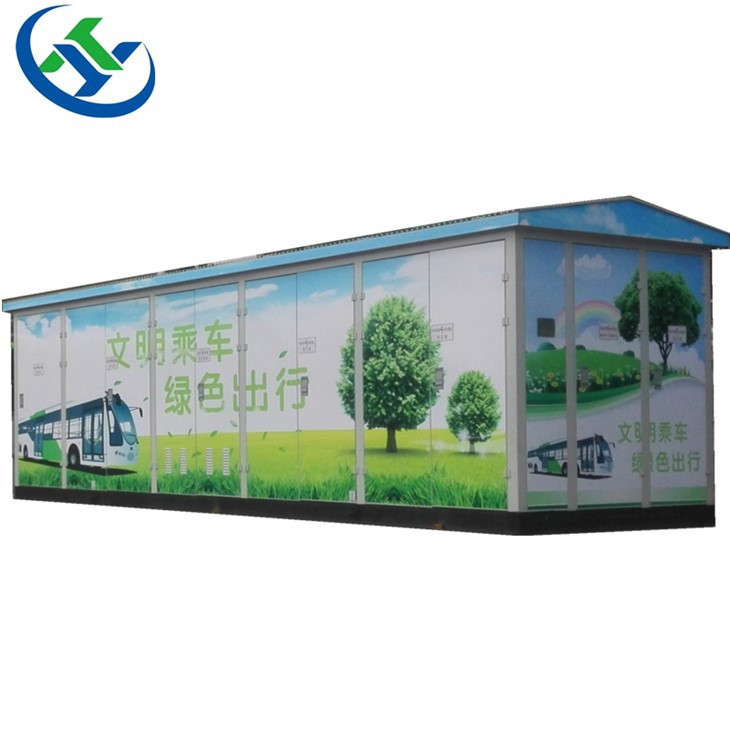

Another popular cooling method is oil - cooling, which is commonly used for transformers within the prefabricated substation. Transformers generate a significant amount of heat during operation, and oil is an excellent medium for transferring and dissipating this heat.
In an oil - cooled transformer, the transformer core and windings are immersed in a special insulating oil. As the transformer operates, the oil absorbs the heat from the core and windings. The heated oil then rises to the top of the transformer tank and is circulated through a cooling system. This cooling system can consist of radiators or heat exchangers. The radiators have fins that increase the surface area for heat transfer. As the hot oil passes through the radiators, the heat is transferred to the surrounding air, and the cooled oil then returns to the bottom of the transformer tank to repeat the cycle.
Oil - cooling offers several advantages. The oil provides electrical insulation as well as cooling, which helps to protect the transformer's internal components. It also has a high heat capacity, meaning it can absorb a large amount of heat without a significant increase in temperature. However, oil - cooling systems require regular maintenance to ensure the oil quality and the proper functioning of the cooling components.
Water - cooling is another option, although it's less common than air - cooling and oil - cooling. Water - cooling systems use water as a coolant to remove heat from the electrical components. There are two main types of water - cooling systems: direct water - cooling and indirect water - cooling.
In direct water - cooling, water comes into direct contact with the hot components. This method is very efficient at removing heat, but it requires a high - quality water source and proper treatment to prevent corrosion and scaling. Indirect water - cooling, on the other hand, uses a heat exchanger. The hot fluid (such as oil or air) from the substation components transfers its heat to the water in the heat exchanger, and then the heated water is cooled in a separate cooling tower or other cooling device before being recirculated.
Water - cooling can provide a very high level of cooling efficiency, but it also has some drawbacks. It requires a reliable water supply, and the installation and maintenance of water - cooling systems can be more complex and expensive compared to air - cooling and oil - cooling.
Now, let's talk about some of the specific applications of prefabricated substations and how the cooling methods might vary. For example, if you're looking at a ZBW Type Prefabricated Substation, the cooling requirements will depend on its size, the type of electrical equipment it houses, and the environment in which it will be installed. A smaller ZBW type substation with lower power ratings may be adequately cooled by a simple air - cooling system, while a larger one with high - power transformers might require oil - cooling or a combination of cooling methods.
Another interesting application is the Prefabricated Substation for EV Charging Piles. As the demand for electric vehicles grows, so does the need for reliable and efficient charging infrastructure. These substations need to be able to handle the high - power loads associated with fast - charging stations. The cooling systems in these substations are crucial to ensure that the electrical components can operate safely and efficiently under heavy use. In many cases, a combination of air - cooling and oil - cooling may be used to manage the heat generated by the transformers and other equipment.
So, there you have it - a rundown of the main cooling methods used in prefabricated substations. Each method has its own advantages and disadvantages, and the choice of cooling method depends on various factors such as the size and power rating of the substation, the ambient temperature and humidity of the installation site, and the specific requirements of the electrical equipment.
If you're in the market for a prefabricated substation and need help deciding on the right cooling method for your application, don't hesitate to reach out. We're here to assist you in finding the perfect solution that meets your needs and budget. Whether you're looking for a small, air - cooled substation for a residential area or a large, oil - cooled substation for an industrial complex, we've got you covered. Let's start a conversation and see how we can work together to get the best prefabricated substation for your project.
References
- Electrical Power Substations Engineering by Turan Gonen
- Handbook of Electric Power Calculations by Hadi Saadat